A Sunset Wedding and Two-Day Photoshoot in Moab: Levi and Jenni's Story
A Sunset Wedding and Two-Day Photoshoot in Moab: Levi and Jenni's Story
There was no venue. No reception hall. No seating chart, no catered dinner, no itinerary built around 200 other people's schedules.
There was the Moab desert, an isolated stretch of BLM land, a campground nearby where they'd been staying, and two full days to do it the way they actually wanted.
Levi and Jenni made it very clear from the start: they didn't want something traditional. What they wanted was something real — a ceremony that meant something, in a place that looked like them, with enough time that it never felt rushed. This is how we built that.
Who Are Levi and Jenni?
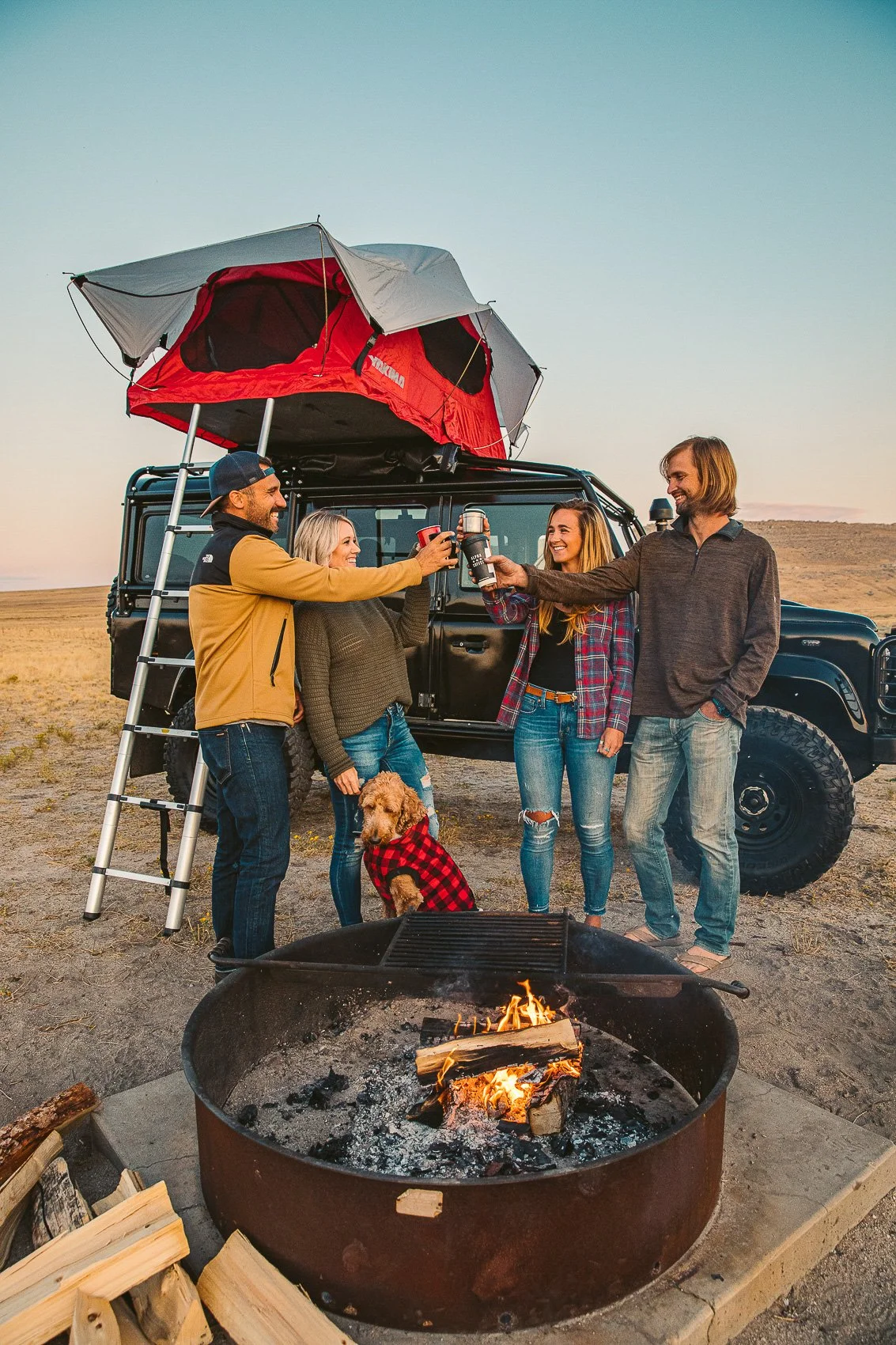
Levi and Jenni are most themselves when they're outside. Nature isn't where they go to relax from their real life — it is their real life. Weekends look like trails, campsites, and drives to places they've never been just to see what's there.
When they started thinking about getting married, a traditional wedding never really entered the conversation. The guest list wasn't the point. The venue wasn't the point. What mattered was the moment itself — and where they were standing when it happened.
They found me through my work in Moab and reached out with a simple ask: they wanted to get married in the desert. They didn't want it to feel like a production. The rest, they said, was up to me.
Why the Moab Desert — and Why No Venue
Moab has a way of clarifying things. You drive out into the desert — past the last gas station, past the last paved road — and the landscape starts to feel almost confrontational in the best possible way. It's vast. It's old. It makes human concerns feel appropriately small.
That's exactly what Levi and Jenni wanted. Not a room decorated to look romantic — actual romance, the kind that comes from being somewhere genuinely extraordinary with someone you chose.
BLM land outside Moab offers something that national parks can't always give you: freedom. No permit lottery, no crowds at the trailhead, no park ranger timeline to work around. You can find a piece of desert that feels entirely yours, and for a ceremony that's supposed to be intimate, that matters enormously.
The fact that they were camping nearby made the whole thing feel even more intentional. They weren't flying in and flying out. They were living in this landscape for a few days, and the ceremony was part of that — not an event dropped into it from the outside.
Day One: The Desert Wedding Ceremony
Camped nearby, ceremony in the open desert
They'd been at a campground close to the ceremony location for a couple of nights before the wedding day. By the time the afternoon rolled around, they knew the light, they knew the space, and they'd had enough time in the desert to feel settled in it. That groundedness shows in the photos — there's no tension of people trying to orient themselves to an unfamiliar place.
We drove to the location together and walked out into the desert from there. No trail, no marked path — just open BLM land stretching out behind the campground, red rock and scrub and silence in every direction. They'd chosen the specific spot themselves the day before. A slight rise in the ground, a view that went on longer than you could reasonably track.
The ceremony itself
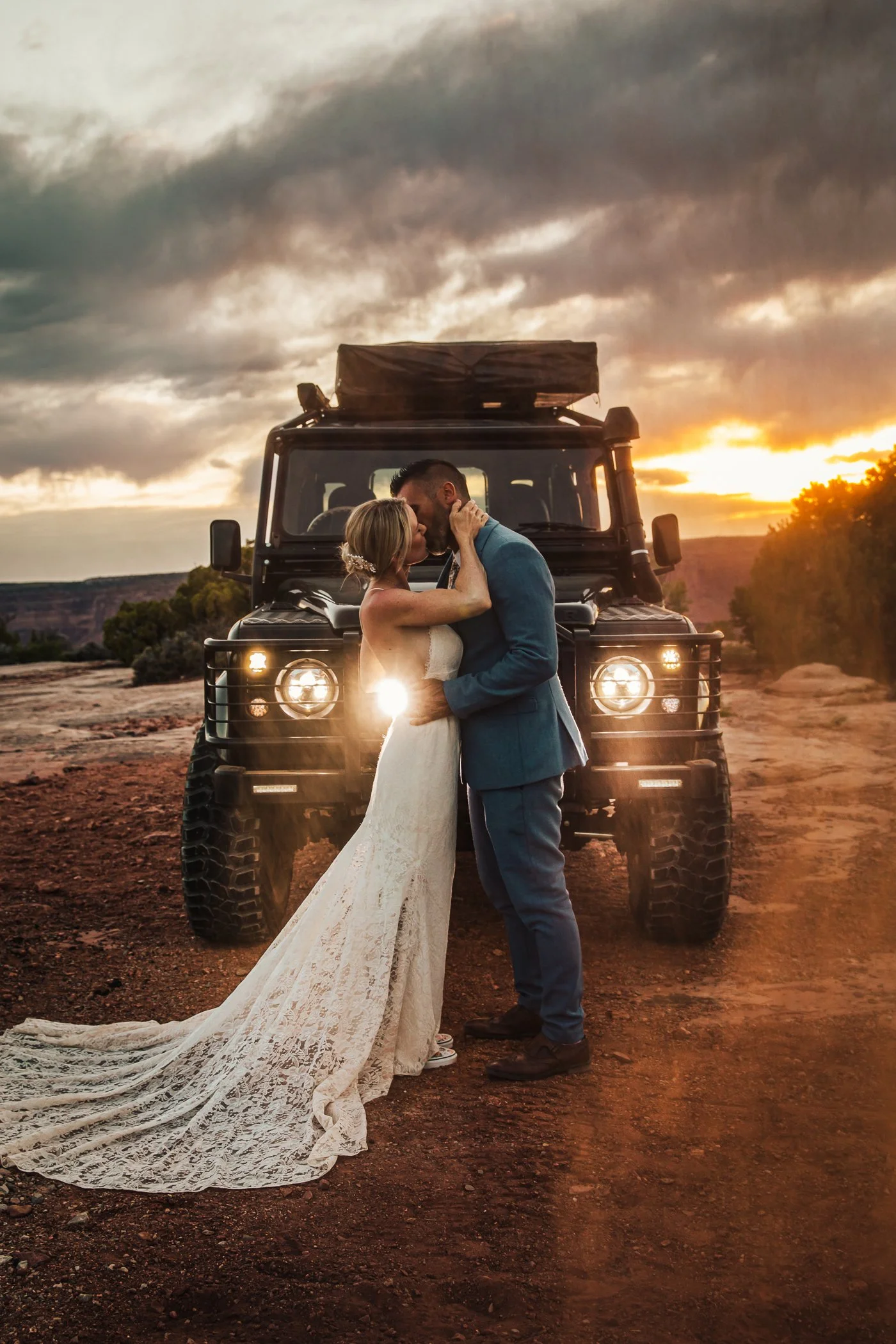
Jenni wore her wedding dress. Levi wore a suit and tie. They were dressed for the occasion — but the occasion was the middle of the desert at golden hour, and that combination is one of my favorite things to photograph. Formal clothing against raw landscape creates a visual tension that makes both elements look better. The dress catches the wind. The suit absorbs the warm light. The desert doesn't care about either, and that indifference is exactly the point.
They'd written their own vows. Simple, direct, specific to them. No borrowed language, no template — the kind of words that could only apply to these two people. Jenni cried. Levi didn't look away.
No officiant nerves, no guests fidgeting in their seats, no anxiety about whether the caterer was going to be on time. Just the two of them in the desert, saying something true.
The golden hour portraits
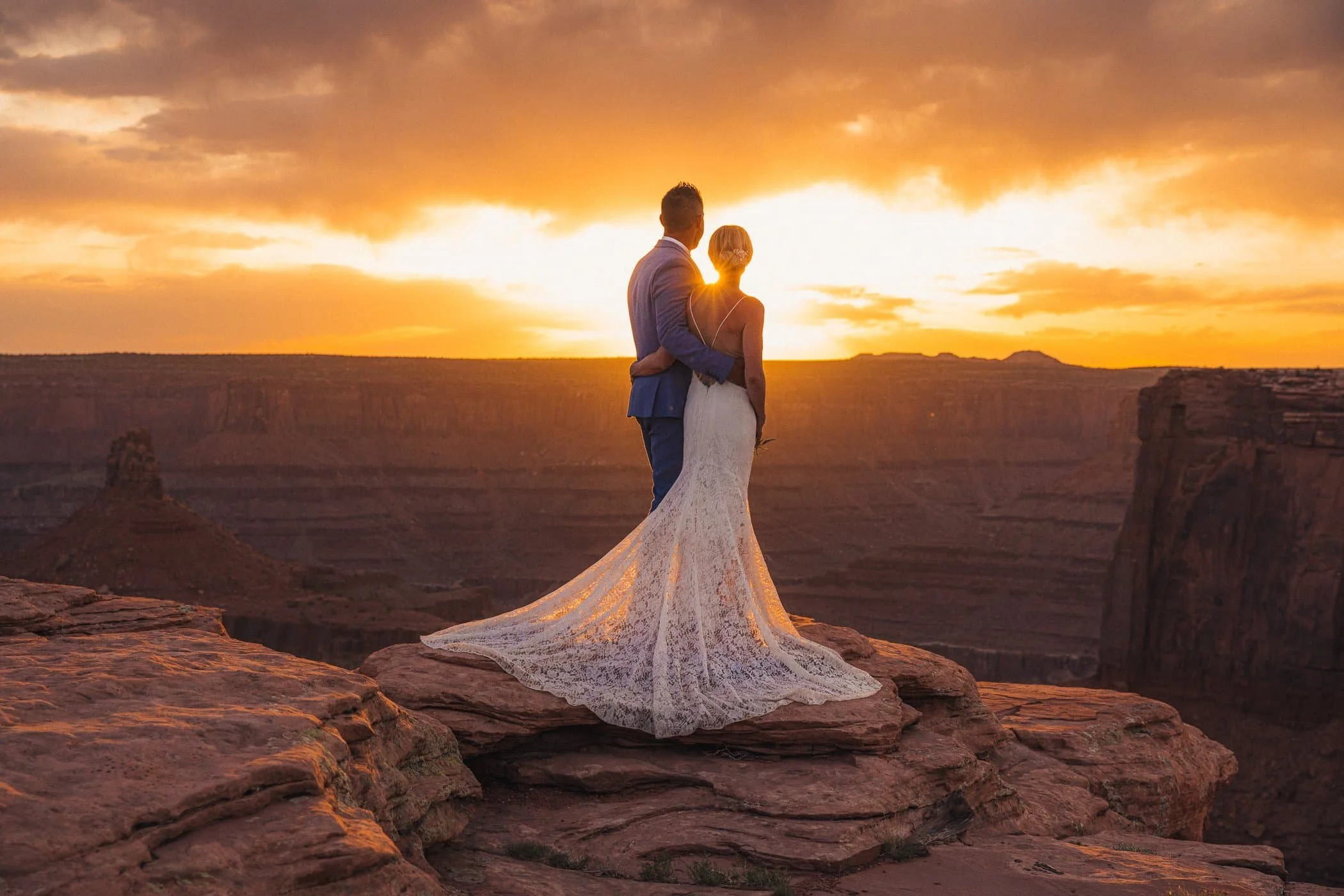
The light in the Moab desert at golden hour is unlike anything else I shoot in. The red rock amplifies the warmth until everything looks like it's been lit from inside. Shadows go long and dramatic. The sky starts doing things that you'd edit out of a photo if you didn't know better, because it doesn't look real.
We had time — which was deliberate. No reception to get back to, no venue with a hard stop. We moved through the desert as the light changed, finding angles and moments as they came. That unhurried pace is something you simply cannot manufacture if you don't build the day around it from the start.
By the time the sun dropped below the horizon, we had everything we needed. And more.
The Decision to Split It Into Two Days
This was one of the smartest choices Levi and Jenni made, and I've started recommending it to couples more often since.
The problem with trying to do everything on one wedding day is pressure. You're emotionally raw from the ceremony, you're trying to be present for the person you just married, and you're also supposed to look composed and intentional in portraits for the next three hours. It's a lot to hold at once, and it shows up in the photos — a certain tightness, a performance creeping in.
Splitting it gave Day One a single job: get married. Be present for the ceremony. Let the portraits happen naturally in the time after.
Then Day Two had a completely different energy — dressed up again, but the weight of the ceremony was behind them. They were just two people in the desert who happened to be wearing their wedding clothes. The pressure was gone, and what replaced it was something much better.
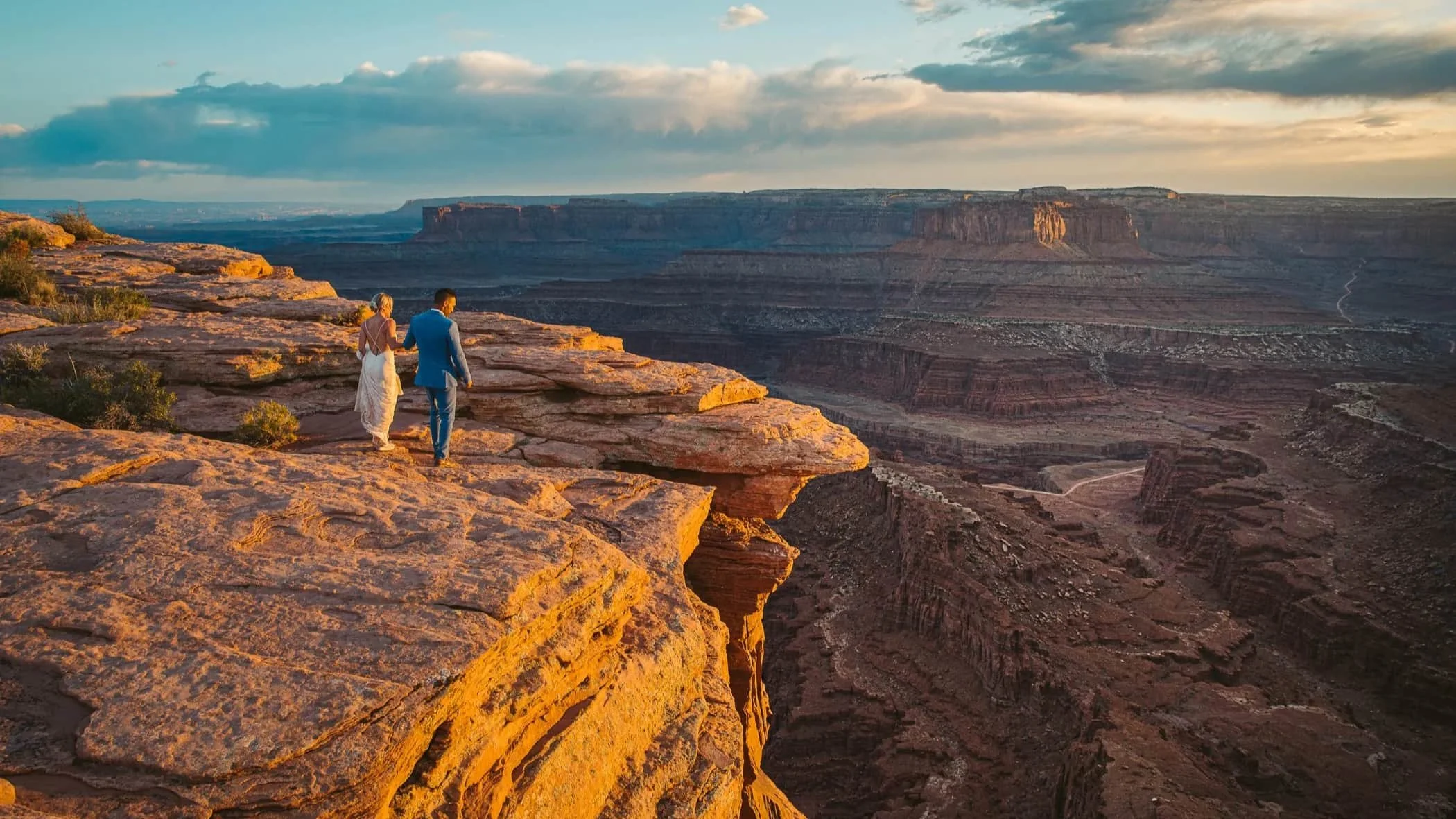
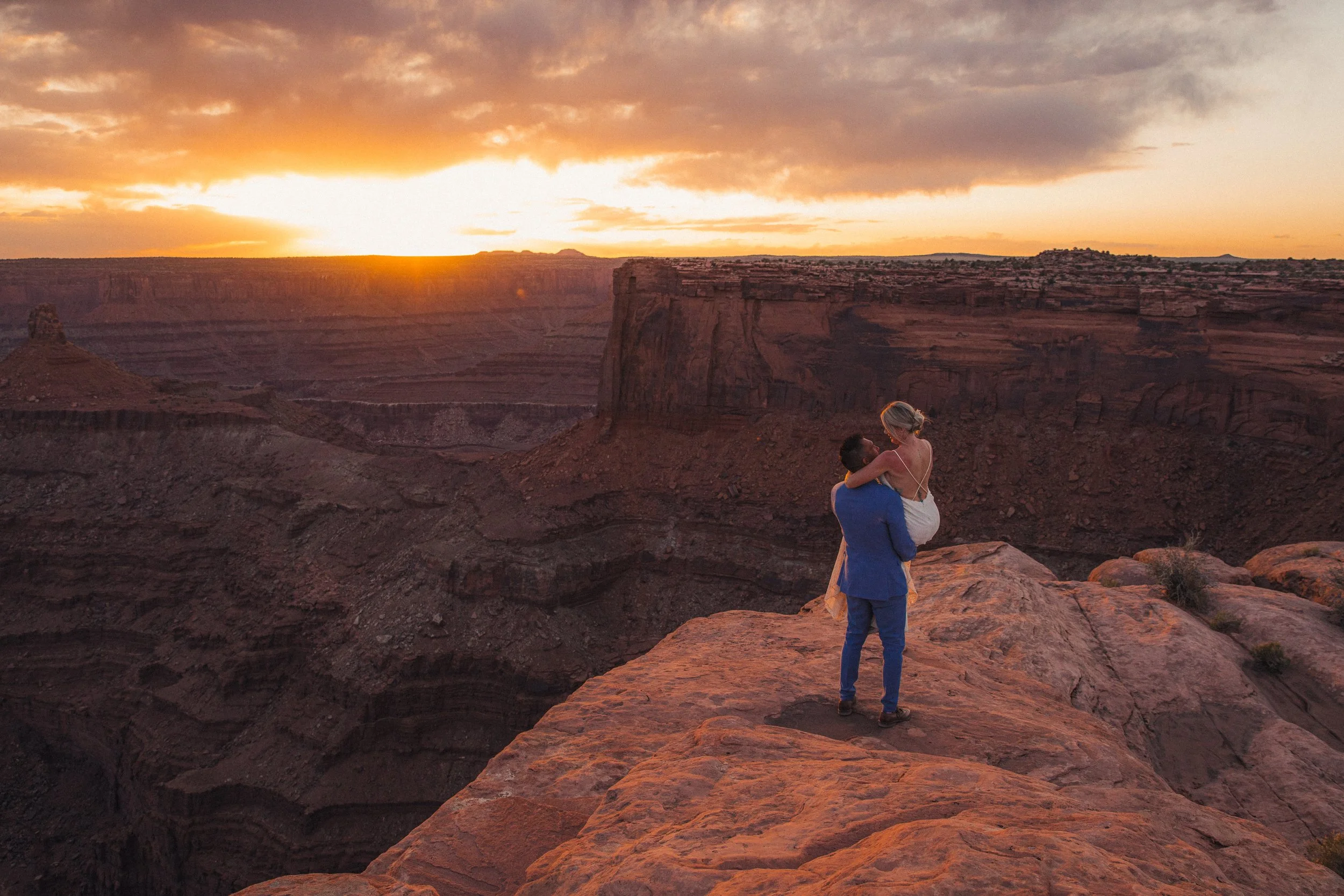
Day Two: Dead Horse Point at Golden Hour
The day after the wedding, with less pressure and more time to explore.
We met in the afternoon on Day Two. Jenni was back in the wedding dress, Levi back in the suit — but everything else was different. They were relaxed in a way that's genuinely hard to describe but immediately visible in photographs. The ceremony was done. They were married. The day had no stakes except to be enjoyable and look beautiful.
That shift in energy is the whole reason the two-day format works. You don't get that version of a couple on the same day as the ceremony. You just don't.
Dead Horse Point at sunset
Dead Horse Point State Park sits on a narrow mesa above a 2,000-foot canyon, with a bend of the Colorado River visible far below. On a map it looks like something you'd draw to illustrate what 'dramatic overlook' means.
In person, the scale stops you. The canyon drops away in every direction, the rock changes color as the sun moves, and at golden hour the whole thing turns shades of orange and red that make every photographer instinct fire at once.
Levi and Jenni stood at the edge of it in their wedding clothes and the landscape did what it always does — it made them look like the most natural thing in the world to be there. That's the quality I look for in a location. Not just that it's beautiful, but that it makes the people in front of it look like they belong.
We worked the light until it was almost gone. The last frames were the best ones — that deep, almost-dark quality where the canyon is just a silhouette and the sky is doing something irreplaceable. Those are the images you keep forever.
Why Moab Works for Weddings Like This — and Elopements Too
Levi and Jenni had a small wedding — intimate by design, not by circumstance. But what made it work was the same set of qualities that make Moab one of the best places in the country for elopements.
Check Out my Blog: Why couples choose Moab
For couples who want an elopement instead
I photograph elopements in Moab throughout the year, and the reasons couples choose it for a wedding and for an elopement are almost identical. The landscape commands presence. The lack of a formal venue means you're not constrained by someone else's rules or timeline. The BLM land gives you access to locations that feel genuinely private — no permit lottery, no crowds, no feeling of being processed through someone else's system.
If Levi and Jenni had wanted to elope instead of have a small wedding, we would have done almost exactly the same day — same locations, same approach, same unhurried pace. The difference between an intimate wedding and an elopement in Moab is mostly just paperwork and headcount. The experience is the same.
Check Out the elopement experiences I Offer
The locations are the same
Dead Horse Point, the BLM desert, the canyon overlooks, the Colorado River bends — these locations don't care whether you're eloping or having an intimate wedding. They give everyone the same thing: scale, solitude, and light that makes almost any photograph look like it cost twice what it did.
That's why I keep coming back to Moab. And it's why couples keep coming here from all over the country — both for weddings and for elopements. If you want a day that feels like yours, this landscape delivers it consistently.
What This Kind of Wedding Actually Costs
A two-day desert wedding and portrait session in Moab runs differently than a traditional venue wedding, and the difference is significant:
Wedding photography, two full days, all travel included: pricing available at authenticelopementco.com/utah-elopement-photographer
Campground or accommodation near Moab: $30–$350/night depending on camping vs. lodging
Utah marriage license (Grand County): ~$50, no waiting period, no residency requirement
Officiant: $0 if a friend gets ordained online, up to $300 for a professional
Simple desert florals from a Moab-area florist: $150–$350
Hair and makeup (optional): $200–$500
Dead Horse Point State Park entrance: $20 per vehicle
A two-day Moab wedding like this typically runs $4,000–$8,000 all-in. A traditional wedding costs $35,000 on average nationally — most of it spent on guests, venues, and vendors whose names you won't remember in five years. Levi and Jenni spent two days doing something they'll talk about for the rest of their lives. The math isn't close.
Is This the Kind of Day You've Been Imagining?
Not every couple is right for this. If you need a large guest list, a reception, and a venue with a catering team, this isn't the approach for you — and that's fine.
But if you've been quietly wondering whether there's a version of getting married that actually feels like you — one that doesn't require you to perform for 200 people, one where the location means something, one where you have enough time to actually be present — then you might be closer to what Levi and Jenni did than you think.
Whether you're planning an intimate desert wedding like theirs, or something smaller — just the two of you eloping on BLM land with no guests and no formality at all — the approach is the same. I handle the location, the timing, the logistics. You show up.
I take on two couples per month by design. If your date is open, let's talk about what your day could look like.
Want the full breakdown on Utah's best elopement spots? Download our free Insider's Guide to Eloping in Utah — locations, permits, timelines, and the stuff most photographers won't tell you.